The word pronoun (from the Latin pro-nomen) simply means 'for the noun', so pronouns are used instead of nouns. We use pronouns to avoid cumbersome repetition of nouns.
In English, as in many other languages, the choice of pronoun to use may differ depending on where it falls in a sentence: that is, whether it is the subject of the verb (She likes cats), the object of the verb (The cat loves her) or the object of a preposition (We gave the cat to her) or whether it has a possessive relationship with a noun or another pronoun (Her cat is a lilac Burmese).
Again, in English, as in many other languages, the term 'case' is used to describe those different possibilities for pronouns. The term 'case' comes from the Latin casus, 'a falling', so case simply refers to where a noun or pronoun falls in a sentence, as described above.
In many European languages, case affects nouns as well as pronouns, so they have to change slightly according to their function, their case. English is simpler because case affects only a few pronouns!
Most people can work out which pronoun to use most of the time. However, there is one situation that even native English speakers find difficult, namely where the pronoun falls as the complement of a verb, as in 'It is I/me'. Think of the complement as part of an equation such as a = b. The complement, which comes from the word 'complete', completes the equation, the statement. In the case of 'It is I/me', subject = subject, so, technically, we should say 'It is I'. Very few people understand this difficult grammatical point, so if you say, 'It is me!' you are in good company!
While there are about 80 pronouns in the pronoun extended family, we can group them into smaller families according to their different types and functions.
| Personal pronouns | I, you, he, she, it, we, they, you, her, him, it, them, us | Subject pronouns (She has arrived.) Object pronouns (We heard from her) |
|---|---|---|
| Indefinite pronouns | all, any, anyone, anything, another, one, no one (= none), nobody, each, either, neither, both, some, several, much, many, few, everyone, everybody, everything | These can act as subject pronouns (Anyone could do it) or as object pronouns (Have you told anyone?) |
| Possessive pronouns | my, mine, your, yours, his, her, hers, our, ours, its, their, theirs (The book is mine) |
It may be easier to see the possessive relationship if, for example, you think of 'The book is mine as 'The book is my book |
| Demonstrative pronouns | this, that, these, those | These can act as subject pronouns (This is our stop) or as object pronouns (I would like that) |
| Interrogative pronouns | who, whom, what, which, whose | Interrogating is questioning (Who could have done this?) |
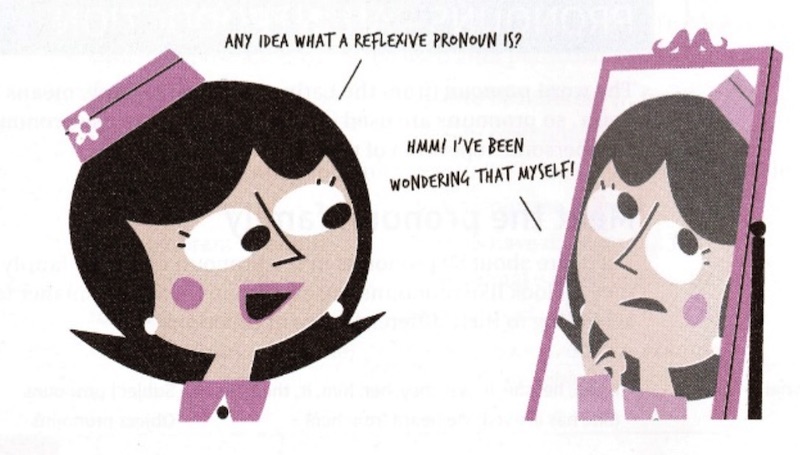
| Reflexive pronouns | myself, yourself, herself, himself, itself, ourselves, yourselves, themselves | Yourself 'reflects' back to you (You should go yourself.) |
| Reciprocal pronouns | each other, one another | re = back; pro = forward (back and forth) (We gave each other a hug.) |
| Relative pronouns | which, that, who, whom, whose, where | These attach clauses. (That is the house where I grew up.) |
| Compound pronouns | whoever, whatever, whichever, whosoever, whatsoever, whichsoever | These act as indefinite, relative or interrogative pronouns (and adverbs). (Choose whichever you like best.) |
| Archaic personal pronouns | thou, ye, thee, thy, thine, thyself | Old fashioned, poetic, Shakespearean, biblical (To thine own self be true.) (If ye love me, keep my commandments.) |