The study of word origins is called etymology (from the Greek etymon, meaning 'true sense' and logia, meaning 'study of', as in biology, radiology, geology.) Dictionaries often show the etymology of words in square brackets. English has an incredibly extensive vocabulary because words have been borrowed from most languages. Here are just a few examples to show you how etymology helps us understand and remember words.
| Anglo-Saxon words | |
|---|---|
| fortnight | a contraction of fourteen nights | Aboriginal words |
| Woomera | a rocket-launching site in Australia named after the Aboriginal throwing stick |
| yakka | as in 'hard yakka', meaning hard work |
| bilby | an Aboriginal name for a type of bandicoot | Arabic words |
| magazine | from makhāzin, a storehouse |
| algebra | from al-jabr, meaning 'restoring broken parts' |
| racquet | probably from raha(t), meaning 'palm of the hand' |
| French words | |
| denim | a cloth 'de Nimes', i.e. from Nimes in France |
| mayday | distress call (Venez) m’aider, meaning 'Help me' (Come to my aid) |
| savant | a wise person, from French savoir, meaning 'to know' | Latin Words |
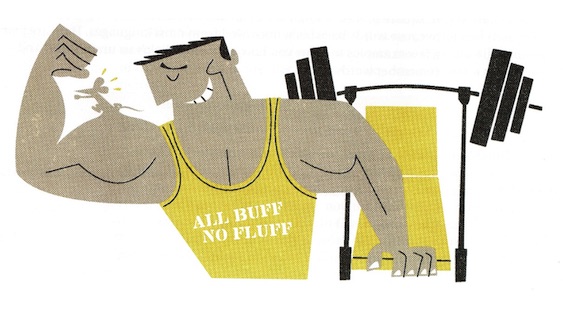
| muscle | from musculus, meaning 'little mouse' (See the cartoon!) |
| quarantine | from quaranta, meaning 'forty' (forty days of isolation) |
| malaria | from mala, 'bad', and aria, 'air' (before it was known that it is mosquitoes that carry the disease, not the air.) | Greek words |
| disaster | from dis, 'bad', and astron, 'a star' (A belief that stars affect fate.) |
| democracy | from demos, 'people', and kratos, 'rule' |
| periscope | from peri, around, and skopion, an instrument for viewing (so a periscope is able to rotate through 360°.) |