
The sentence 'The engineer built a robot' has only one verb (built), so we say that it is a simple sentence. That simple sentence also happens to be a clause. The term 'clause' comes from the Latin claudere (to close), as in include (to enclose). Thus, a clause is just a complete, closed grouping of words with their own verb (in other words, with a subject and predicate). Why then do we need the term 'clause' as well as 'sentence'?
The answer is easy: the simple sentence is one type of clause but there are also other types of clauses. We use those other types of clauses to add layers of extra information to simple sentences. Those extra clauses are introduced by words like 'who', 'which', 'when', 'because'...and they have their own verbs. When that happens, the sentence is no longer simple; we say it is complex. The sentence is more "complicated" because it has more than one clause and so more than one verb.
To give you the idea, here are some examples of complex sentences. Notice how more information has been added by the addition of clauses with their own verbs. (The different verbs are in bold.)
- The engineer built a robot that could change car tyres. (one additional clause)
- The engineer built a robot that could change car tyres because a lot of workers had injured their backs lifting heavy tyres. (two additional clauses)
- When approval had been granted, the engineer who had been employed by the company because he was a robotics engineer built a robot that was able to change car tyres. (four additional clauses)
At the heart of those complex sentences is a simple sentence (The engineer built a robot). It is the main clause, the principal clause. Notice that while we can add other clauses to that simple sentence to make it more complex, those clauses cannot stand on their own; they are dependent clauses - dependent in the sense that they have meaning only through how they relate to parts of the main clause... just as arms and legs cannot exist without having a body to be attached to!
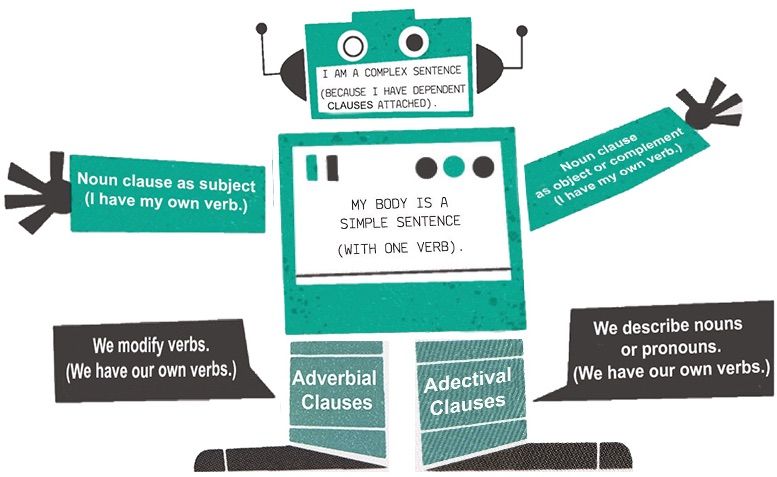
You will see that there are three types of dependent clauses that can be added to a simple sentence (the independent clause) to make it a complex sentence with many verbs.
Don't worry if you are not sure yet how those dependent clauses are different; their different functions are explained below. You will learn that there are three types of dependent clauses: noun clauses, adjectival clauses and adverbial clauses. However, at this stage the main thing to understand is that because they are clauses and contain their own verbs, the addition of one or more of these dependent clauses to a simple sentence increases the complexity of the sentence. As you become skilled at recognizing the different clauses, you will be able to place them more precisely in complex sentences.
Now that you have been introduced to the broad idea of clauses, let us go back to our simple sentence and build up more complex sentences in easy steps. The following table starts with the simple sentence The engineer built a robot and shows how we build up the complexity of sentences by adding information, such as dependent clauses.