
EXPLANATION In English, we change the verb in some way to indicate the time of the action (the tense): for example, was indicates past tense, is indicates present tense and will be indicates future tense. Furthermore, verbs also indicate what we call aspect: that is, they indicate whether actions are being viewed as simple, completed or continuous within a tense. Let us look at three examples set in the past.
- Simple past: Ben saved his money to buy a car.
- Continuous past: Last year, Ben was saving his money to buy a car.
- Completed past: Ben had saved half of what he needed by September.
The tense and aspect of verbs convey varying shades of meaning as we look forwards and backwards in time. The timeline below indicates three continuous periods: A to D is a period in the past, E to H is a period in the present and I to L is a period in the future.
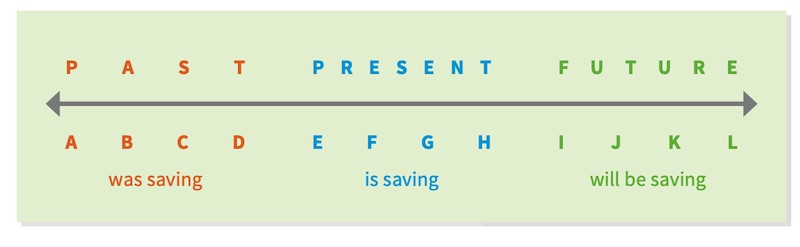
Sentence 2 above refers to the continuous period in the past, from A to D: Ben was saving his money over the period of time A to D.
Sentence 3 above is of particular interest: Ben had saved half of what he needed by September. Where do we place it on the time line?
The answer is that it refers to somewhere around C. Because we are looking back to a point in the past where something has been completed, the verb had saved is called past completed tense. With past completed tense, we look back to a point in the past with a strong sense that it is the end point of activity that has preceded it. Another example would be to look back to A and beyond with a statement such as:
Before Ben started saving for a car, he had not been careful with his money.
The future tense works the same way. We might say that next year Ben will be saving for a house (future continuous) and that by the end of the year he hopes that he will have saved enough for a deposit. If we call L the point where the deposit will have been saved (completed), then before that (I to L) is the period when he will have been saving (continuous).
In the present, we can say that Ben is saving (continuous - E to H) and that so far he has saved a certain amount (completed - at a specific point such as F or G).
In the discussion above, the terms continuous and completed have been used because they are easy to understand. Note that traditional grammars use the term imperfect instead of continuous and perfect instead of completed.
In the typical error above - When I graduated, I was very happy because I achieved my goal - the writer has incorrectly used the simple past tense verb achieved instead of the past perfect verb had achieved. He is looking back to when he graduated with a sense of the work done up until that point, so by the time he had reached his graduation, he had achieved his goal.
| Tense | ||||
|---|---|---|---|---|
| Past | Present | Future | ||
| Aspect | Simple | She swam her fastest times ever in April | She swims regularly | She will swim the last leg of the relay |
| Present | She was swimming well by the time she went to school | She is swimming faster than ever before. | She will be swimming in the next event. | |
| Future | She had swum in the 100 metre freestyle event before swimming the 800 metre freestyle. | She has swum 10 lengths already this morning. | She will have swum five events by the end of the carnival. | |